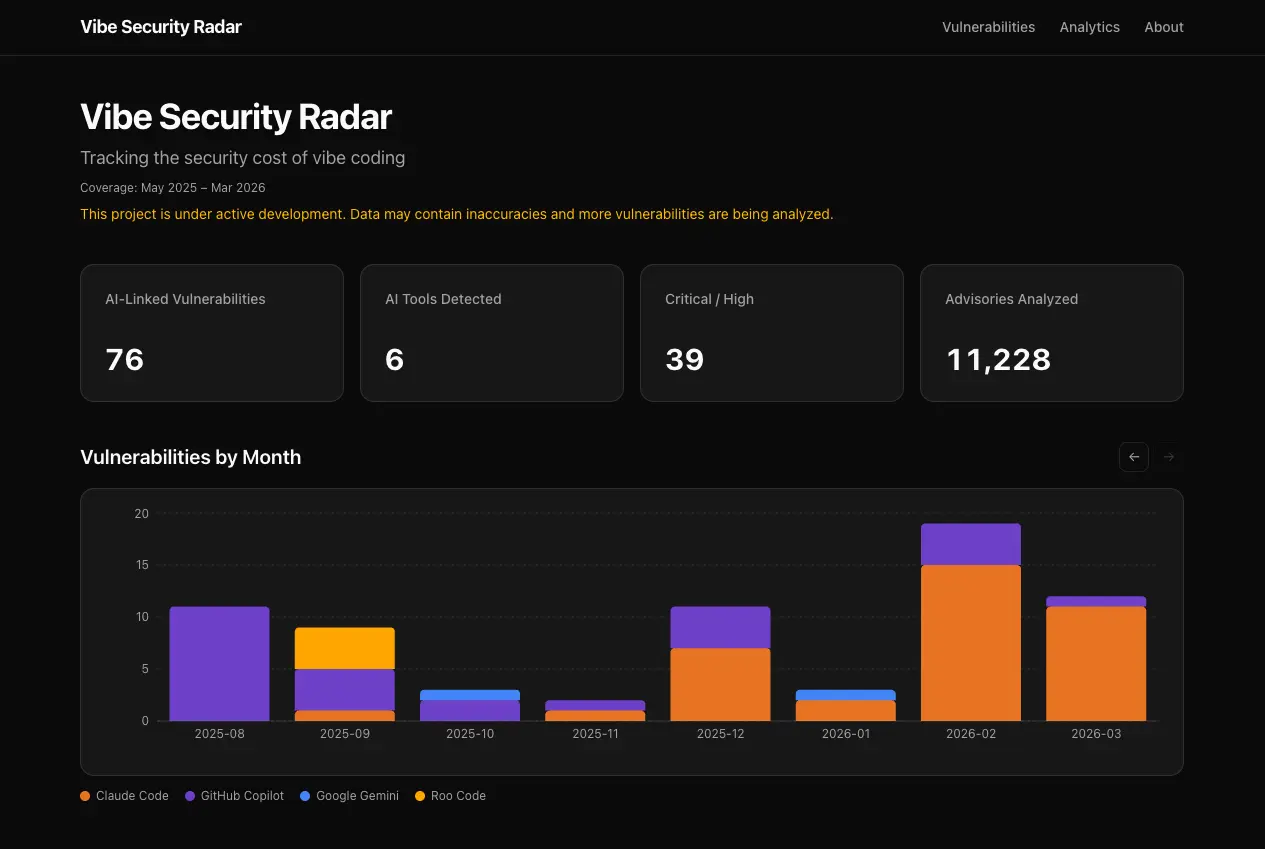
Vibe coding — the practice of describing what you want in natural language and letting an AI assistant generate the code — has become the fastest-growing development paradigm of 2025-2026. But speed comes at a cost. A new open-source research project called Vibe Security Radar is now putting hard numbers on what that cost looks like: 76 confirmed security vulnerabilities introduced directly by AI coding assistants across 11,228 analyzed security advisories.
The tracker, built by a Georgia Institute of Technology researcher, is live at vibe-radar-ten.vercel.app and covers advisories published between May 2025 and March 2026. Of the 76 identified flaws, 39 are rated Critical or High severity.
Which AI Tools Are Introducing Vulnerabilities?
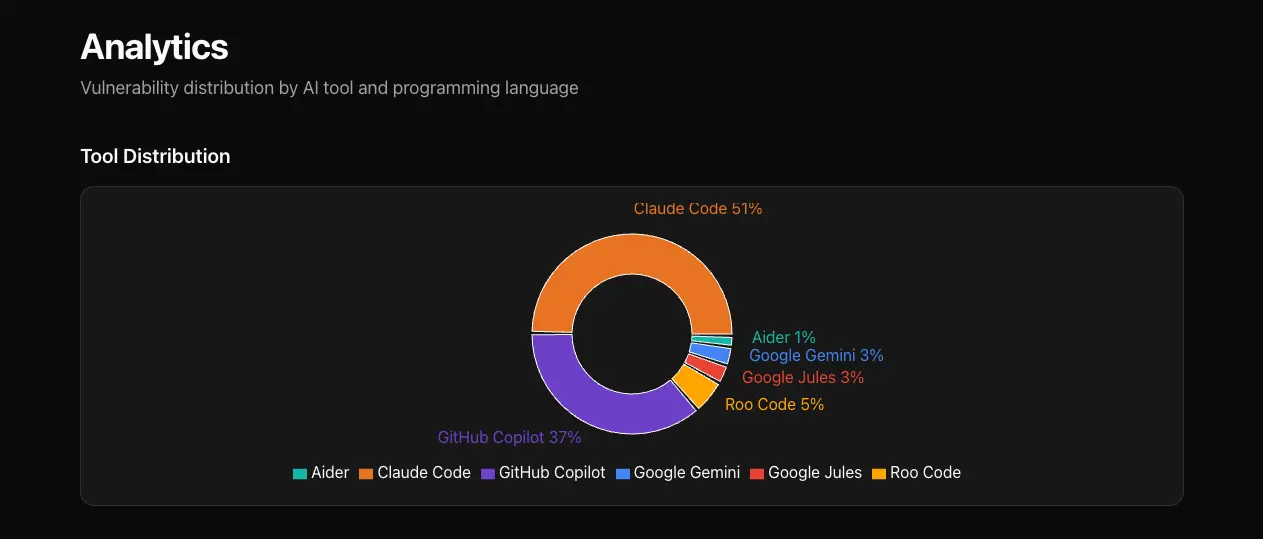
Anthropic's Claude Code accounts for the highest count with 40 vulnerabilities — 11 Critical, 12 High, 5 Medium, 11 Low, and 1 Unknown. GitHub Copilot follows with 29 vulnerabilities (2 Critical, 9 High, 10 Medium, 8 Low), representing approximately 37% of all tracked AI-linked vulnerabilities.
The remaining detections are spread across Roo Code (4 vulnerabilities, 3 High), Google Jules (2 vulnerabilities, 1 Critical), Google Gemini (2 vulnerabilities), and Aider (1 Critical vulnerability). The project monitors signatures from 40 AI coding tools total — including Cursor, Devin, Windsurf, Amazon Q, Cline, Lovable, and Replit Agent — but only six have produced confirmed vulnerability introductions so far.
Language Breakdown: TypeScript and Python Lead
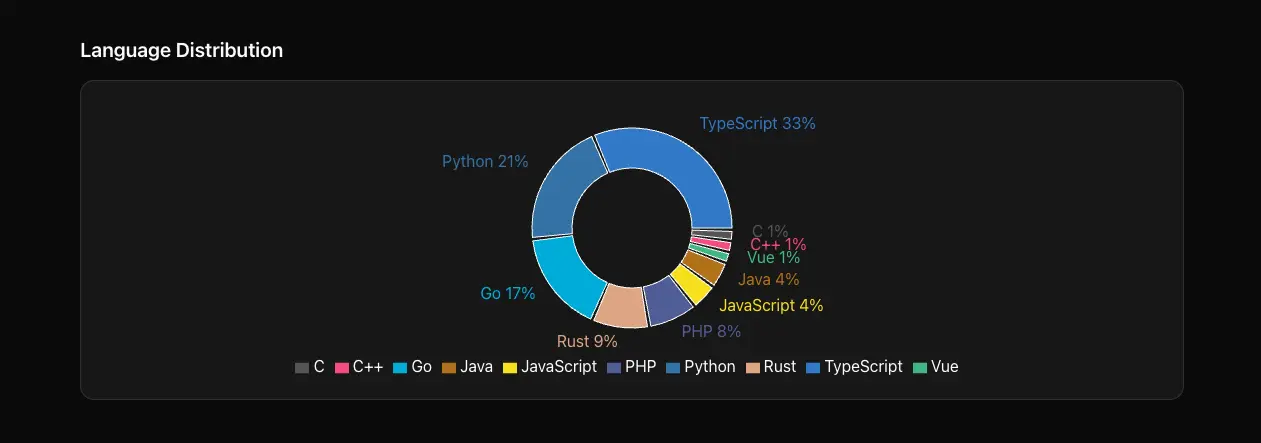
TypeScript leads with 25 AI-introduced vulnerabilities (3 Critical, 11 High), making up roughly 33% of all findings. Python follows at 16 (3 Critical, 5 High) and Go at 13. PHP stands out with only 6 vulnerabilities but 5 of them Critical — the highest critical-to-total ratio of any tracked language.
Rust produced 7 AI-introduced vulnerabilities despite its memory-safety guarantees, indicating that AI tools can introduce logic-level and injection flaws regardless of language-level protections. Java, JavaScript, Vue, C++, and C round out the list with smaller counts.
How It Works: Six-Tier Verification Pipeline
What sets Vibe Security Radar apart from surface-level correlation is its methodology for proving causation. The project processes each vulnerability through a six-tier pipeline:
- Tiers 1-2: Bulk ingestion of advisories from OSV.dev, the GitHub Advisory Database (local clone), and NVD reference URL parsing to extract fix-commit links.
- Tier 3: GitHub commit search as a fallback when advisory databases lack fix-commit SHAs.
- Tier 4: SZZ-style git blame analysis tracing fix commits back to the original bug-introducing commits, restricted to security-relevant files identified by LLM analysis.
- Tier 5: AI signature detection — scanning bug-introducing commits for co-author trailers, bot email addresses, commit message markers, and tool-specific metadata. Known CI/CD bots (Dependabot, Renovate, GitHub Actions) are explicitly filtered out to prevent false positives.
- Tier 6: Two-phase LLM causality verification using Gemini 3.1 Flash Lite. Phase 1 analyzes the fix commit to understand the vulnerability type, root cause, and vulnerable code pattern. Phase 2 evaluates each AI-signaled commit against that context to determine whether it actually introduced the flaw, producing a structured verdict with causal chain analysis.
Vulnerabilities where all AI-signaled commits are judged UNRELATED or UNLIKELY are filtered out, significantly reducing false positives compared to file-level blame alone.
Most Affected Repositories
The top affected open-source projects include openclaw/openclaw with 11 vulnerabilities, mattermost/mattermost-plugin-confluence with 8, and coollabsio/coolify with 5 — all rated Critical. Notably, roocodeinc/roo-code appears with 4 vulnerabilities, meaning Roo Code's own codebase contains AI-introduced security flaws. The Model Context Protocol Python SDK (modelcontextprotocol/python-sdk) also shows 2 High-severity vulnerabilities.
Limitations
The project is transparent about its constraints. Detection only works when AI tools leave explicit signatures in git commits — tools that do not embed metadata are invisible. Git blame can misattribute lines in edge cases, and the lightweight LLM used for verification may misclassify borderline cases. Only publicly disclosed vulnerabilities with available fix commits can be analyzed, meaning closed-source and unpatched flaws are not covered.
What This Means for Vibe Coders
Vibe Security Radar provides the first systematic, evidence-based dataset for measuring the security tradeoff of AI-assisted development. The data shows that vibe-coded projects are particularly susceptible to injection vulnerabilities, authorization bypasses, and improper input validation — the vulnerability classes where contextual understanding of application logic matters most and where AI tools are weakest.
For security teams evaluating AI coding tool adoption, this tracker offers a reference point for understanding which tools and languages carry the highest risk. For developers building with AI assistance, it reinforces that human code review remains essential — especially for security-sensitive logic that AI tools generate fluently but not always safely.
The project is under active development and the vulnerability count is expected to grow as more advisories are analyzed.